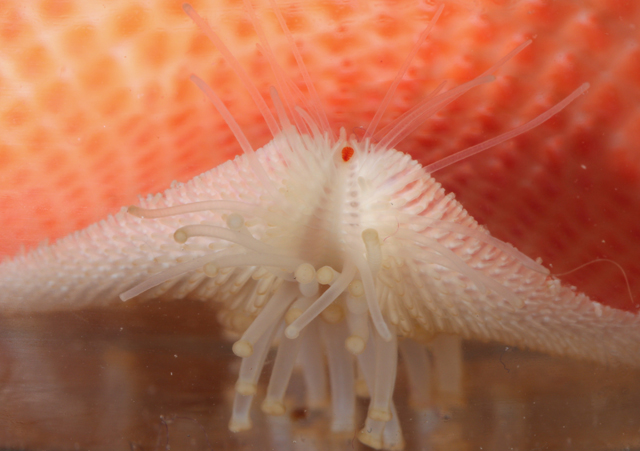
Starfish in the Deep Sea Can See

A study of 13 starfish species reveals that even animals that live at depths where sunlight doesn’t reach have functioning eyes.

Written byAbby Olena, PhD
| 4 min read

Register for free to listen to this article
Listen with Speechify
0:00
4:00
Share

Tremaster mirabilis bends an arm to direct its gaze.MARIE HELENE BIRK, UNIVERSITY OF COPENHAGENSome animals that spend their whole lives in the dark—species of fish that thrive in caves, for instance—have dispensed with eyes all together. But in a study published today (February 7) in Proceedings of the Royal Society B, researchers have shown that several types of starfish that live in the deep ocean have working compound eyes at the tips of their arms, much like related species that dwell in shallower water.

“There’s been a lot of work over the years on vision in a variety of fish from shallow water to the deep sea, but there hasn’t been much at all done on vision in animals that sit on the bottom,” says Thomas Cronin, a biologist at University of Maryland, Baltimore County, who did not participate in the work. “It’s a been a question for a long time, what exactly are eyes used for down in these great depths?”

While earlier studies had shown that some starfish that live in shallower, brighter water have and use compound eyes, no one had previously looked at animals occupying the sea floor. “What you see in many other animal groups is that, when you venture deeper into the sea ...

Interested in reading more?

Become a Member of

The Scientist Logo
Receive full access to more than 35 years of archives, as well as TS Digest, digital editions of The Scientist, feature stories, and much more!
Already a member? Login Here

Related Topics

Meet the Author

  • abby olena

    As a freelancer for The Scientist, Abby reports on new developments in life science for the website. She has a PhD from Vanderbilt University and got her start in science journalism as the Chicago Tribune’s AAAS Mass Media Fellow in 2013. Following a stint as an intern for The Scientist, Abby was a postdoc in science communication at Duke University, where she developed and taught courses to help scientists share their research. In addition to her work as a science journalist, she leads science writing and communication workshops and co-produces a conversational podcast. She is based in Alabama.  

    View Full Profile
Share
Illustration of a developing fetus surrounded by a clear fluid with a subtle yellow tinge, representing amniotic fluid.
January 2026, Issue 1

What Is the Amniotic Fluid Composed of?

The liquid world of fetal development provides a rich source of nutrition and protection tailored to meet the needs of the growing fetus.

View this Issue
Skip the Wait for Protein Stability Data with Aunty

Skip the Wait for Protein Stability Data with Aunty

Unchained Labs
Graphic of three DNA helices in various colors

An Automated DNA-to-Data Framework for Production-Scale Sequencing

illumina
Exploring Cellular Organization with Spatial Proteomics

Exploring Cellular Organization with Spatial Proteomics

Abstract illustration of spheres with multiple layers, representing endoderm, ectoderm, and mesoderm derived organoids

Organoid Origins and How to Grow Them

Thermo Fisher Logo

Products

nuclera logo

Nuclera eProtein Discovery System installed at leading Universities in Taiwan

Brandtech Logo

BRANDTECH Scientific Introduces the Transferpette® pro Micropipette: A New Twist on Comfort and Control

Biotium Logo

Biotium Launches GlycoLiner™ Cell Surface Glycoprotein Labeling Kits for Rapid and Selective Cell Surface Imaging

Colorful abstract spiral dot pattern on a black background

Thermo Scientific X and S Series General Purpose Centrifuges

Thermo Fisher Logo