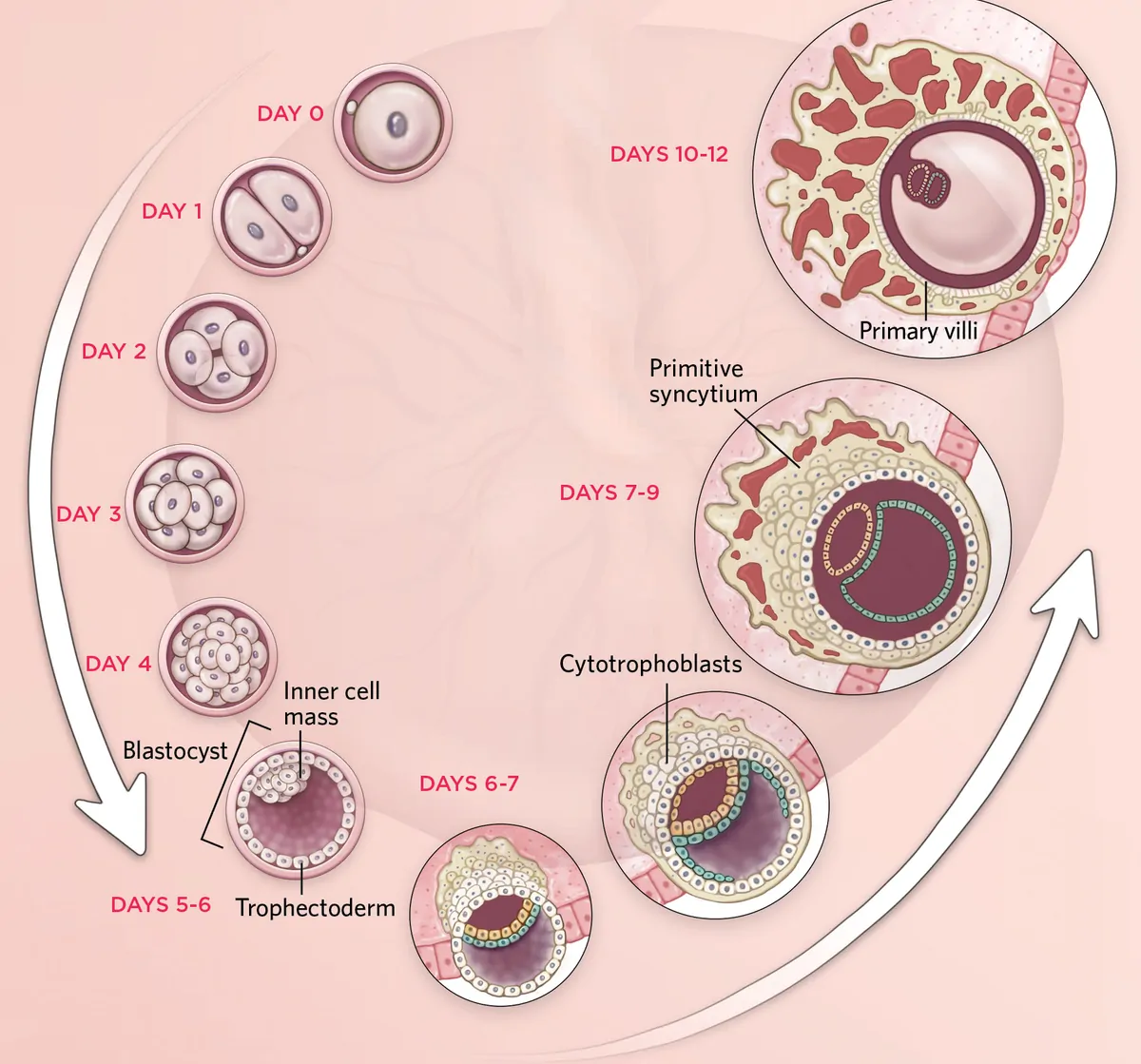
Infographic: Early Placenta Development Sets the Stage

During early pregnancy, the placenta remodels the uterine environment to support fetal growth

Written byDanielle Gerhard, PhD
| 2 min read

Register for free to listen to this article
Listen with Speechify
0:00
2:00
Share

DAYS 5-6

Approximately five days post fertilization (dpf), the blastocyst develops. The inner cell mass gives rise to the fetus, while the surrounding trophectoderm transforms into the placenta.

DAYS 6-7

Six to seven dpf, the blastocyst attaches to the uterine wall and begins its invasion.1

DAYS 7-9

After implantation, the trophectoderm starts reshaping the endometrium. A layer of cytotrophoblasts—trophoblast progenitor cells—emerges around the same time as the invading primitive syncytium.

DAYS 10-12

By 12 dpf, cytotrophoblast cells begin to penetrate the primitive syncytium to form primary villi, which later form the villous placenta.

From weeks three to 10, cytotrophoblast cells escape into the decidua, a specialized layer of endometrium, and differentiate into extravillous trophoblasts. These invading cells remodel spiral arteries to reroute parental blood to the intervillous space.2

By the beginning of the second trimester, the cytotrophoblast plug breaks down and parental blood begins to enter the intervillous space.

  1. Turco MY, Moffett A. Development of the human placenta. Development. 2019;146(22):dev163428.
  2. Horii M, et al. Modeling human trophoblast, the placental epithelium at the maternal fetal interface. Reproduction. 2020;160(1):R1-R11.

Read the full story.

Related Topics

Meet the Author

  • Black and white photo of Danielle Gerhard

    Danielle is a Senior Editor at The Scientist. She earned her PhD in psychology and behavioral neuroscience from Yale University and completed a postdoctoral fellowship in neuroscience Weill Cornell Medicine. Her research explored the cellular and molecular mechanisms of stress and depression across development. She has served as editor-in-chief of the Yale Journal of Biology and Medicine, contributed stories to BioTechniques News and Drug Discovery News, and engaged in various science outreach initiatives across Connecticut and NYC.

    View Full Profile

Published In

December 2023 issue cover
Winter 2023

Ephemeral Life

Recent advances in modeling the human placenta may inform placental disorders like preeclampsia

Share
You might also be interested in...
Loading Next Article...
You might also be interested in...
Loading Next Article...
Illustration of a developing fetus surrounded by a clear fluid with a subtle yellow tinge, representing amniotic fluid.
January 2026, Issue 1

What Is the Amniotic Fluid Composed of?

The liquid world of fetal development provides a rich source of nutrition and protection tailored to meet the needs of the growing fetus.

View this Issue
Skip the Wait for Protein Stability Data with Aunty

Skip the Wait for Protein Stability Data with Aunty

Unchained Labs
Graphic of three DNA helices in various colors

An Automated DNA-to-Data Framework for Production-Scale Sequencing

illumina
Exploring Cellular Organization with Spatial Proteomics

Exploring Cellular Organization with Spatial Proteomics

Abstract illustration of spheres with multiple layers, representing endoderm, ectoderm, and mesoderm derived organoids

Organoid Origins and How to Grow Them

Thermo Fisher Logo

Products

Brandtech Logo

BRANDTECH Scientific Introduces the Transferpette® pro Micropipette: A New Twist on Comfort and Control

Biotium Logo

Biotium Launches GlycoLiner™ Cell Surface Glycoprotein Labeling Kits for Rapid and Selective Cell Surface Imaging

Colorful abstract spiral dot pattern on a black background

Thermo Scientific X and S Series General Purpose Centrifuges

Thermo Fisher Logo
Abstract background with red and blue laser lights

VANTAstar Flexible microplate reader with simplified workflows

BMG LABTECH







