Imaging Musical Improv

Some areas of the brain that typically process language are active in jazz musicians who are improvising, a study shows.

Written byAbby Olena, PhD
| 2 min read

Register for free to listen to this article
Listen with Speechify
0:00
2:00
Share

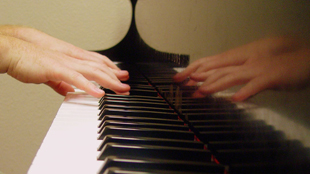
FLICKR, MIDIMANAnyone who has listened to jazz knows that at times the performers seem to be having a musical conversation. It now seems as though this conversation is reflected in the neural activation of the musicians’ brains. In a study published in PLOS One this week (February 19), researchers from the Johns Hopkins School of Medicine in Baltimore, Maryland, showed that some regions of the brain associated with language were active in the brains of two jazz musicians as they improvised with one another.

“Until now, studies of how the brain processes auditory communication between two individuals have been done only in the context of spoken language,” coauthor Charles Limb said in a statement. “But looking at jazz lets us investigate the neurological basis of interactive, musical communication as it occurs outside of spoken language.”

The team performed functional magnetic resonance imaging (fMRI) on the brains of eleven jazz pianists as they traded portions of a scale, alternated parts of a memorized piece of music, and improvised on a keyboard with another pianist in the control room, whom they could hear through headphones. As the musicians improvised, the researchers observed intense activation in the players’ Broca’s and Wernicke’s areas of the brain, which are classically associated with language. Another ...

Interested in reading more?

Become a Member of

The Scientist Logo
Receive full access to more than 35 years of archives, as well as TS Digest, digital editions of The Scientist, feature stories, and much more!
Already a member? Login Here

Related Topics

Meet the Author

  • abby olena

    As a freelancer for The Scientist, Abby reports on new developments in life science for the website. She has a PhD from Vanderbilt University and got her start in science journalism as the Chicago Tribune’s AAAS Mass Media Fellow in 2013. Following a stint as an intern for The Scientist, Abby was a postdoc in science communication at Duke University, where she developed and taught courses to help scientists share their research. In addition to her work as a science journalist, she leads science writing and communication workshops and co-produces a conversational podcast. She is based in Alabama.  

    View Full Profile
Share
Image of a man in a laboratory looking frustrated with his failed experiment.
February 2026

A Stubborn Gene, a Failed Experiment, and a New Path

When experiments refuse to cooperate, you try again and again. For Rafael Najmanovich, the setbacks ultimately pushed him in a new direction.

View this Issue
Human-Relevant In Vitro Models Enable Predictive Drug Discovery

Advancing Drug Discovery with Complex Human In Vitro Models

Stemcell Technologies
Redefining Immunology Through Advanced Technologies

Redefining Immunology Through Advanced Technologies

Ensuring Regulatory Compliance in AAV Manufacturing with Analytical Ultracentrifugation

Ensuring Regulatory Compliance in AAV Manufacturing with Analytical Ultracentrifugation

Beckman Coulter logo
Conceptual multicolored vector image of cancer research, depicting various biomedical approaches to cancer therapy

Maximizing Cancer Research Model Systems

bioxcell

Products

Sino Biological Logo

Sino Biological Pioneers Life Sciences Innovation with High-Quality Bioreagents on Inside Business Today with Bill and Guiliana Rancic

Sino Biological Logo

Sino Biological Expands Research Reagent Portfolio to Support Global Nipah Virus Vaccine and Diagnostic Development

Beckman Coulter

Beckman Coulter Life Sciences Partners with Automata to Accelerate AI-Ready Laboratory Automation

Refeyn logo

Refeyn named in the Sunday Times 100 Tech list of the UK’s fastest-growing technology companies